
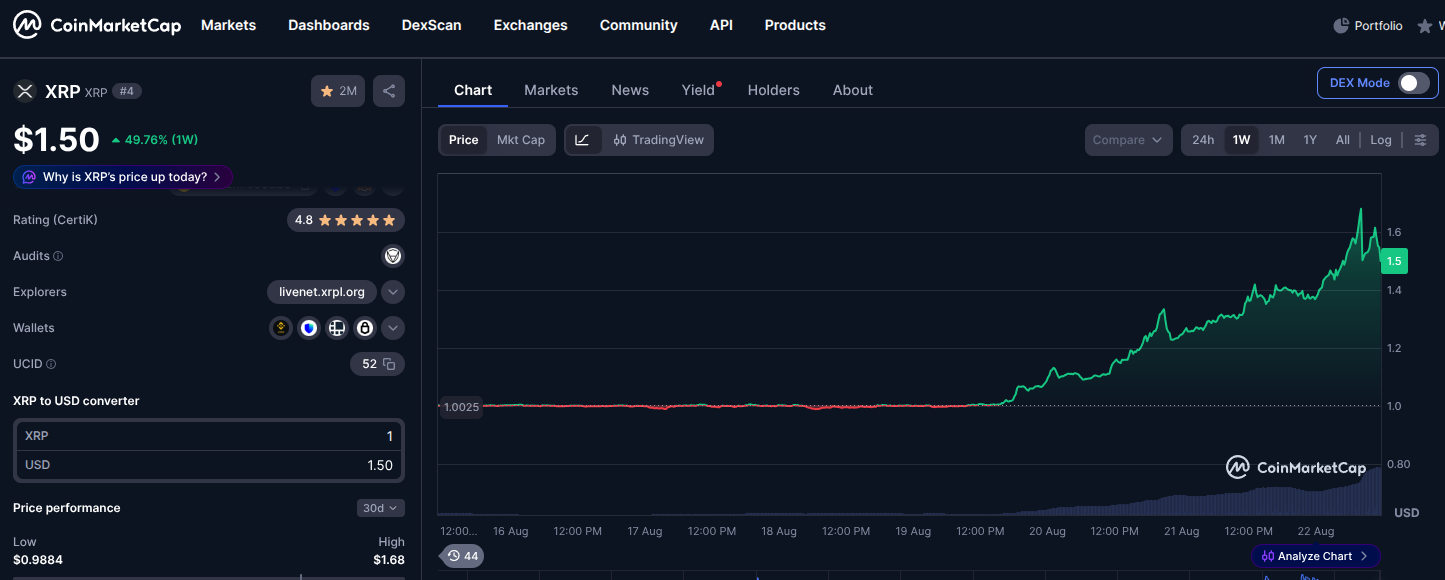
XRP crossed $1.65 on August 22, 2026 after CoinMarketCap’s supplied 30-day price-performance range recorded a low of $0.9884 and a high of $1.68. The rally is encouraging for investors, but a higher market value makes accurate cost basis, disposal records and transfer matching more important—especially for people using several exchanges or wallets.
Market snapshot: August 22, 2026. Crypto prices change continuously. This article is educational, not financial, tax, legal or security advice.
What drove XRP’s 30-day recovery?
XRP advanced as broader crypto liquidity improved and bearish positioning was challenged. Once price broke through resistance, short sellers closing leveraged trades added forced demand. Momentum buyers then amplified a move that had begun near the psychologically important $1 level.
Possible contributors to the move include a broad crypto rally, forced closure of bearish positions, improving liquidity expectations and renewed institutional attention around Ripple and XRP Ledger infrastructure. Ripple also announced August investments intended to expand regulated transfer-agency, tokenization and collateral-mobility capabilities on XRPL. These developments can improve sentiment, but they do not prove that any single event caused the price change.
The result was a 30-day range stretching from $0.9884 to $1.68. The move from the low to the $1.65 milestone was approximately 66.9%. That percentage describes past performance within the supplied snapshot; it is not a forecast.
Why a price rally creates record-keeping questions
A chart can show an unrealized gain without creating the same reporting outcome as a sale, depending on the jurisdiction. Selling XRP for fiat, swapping it for another token or spending it may be treated as a disposal in many tax systems. Transfers between wallets controlled by the same owner are often different, but fees and incomplete exchange data can complicate matching.
Tax treatment varies by country and individual circumstances. Investors should use official local guidance or a qualified professional rather than assuming that one universal rule applies.
Cost basis matters more than the current quote
To calculate a gain or loss, a taxpayer generally needs acquisition date, quantity, acquisition value, disposal proceeds and associated fees. Someone who bought XRP at several prices cannot determine the result simply by comparing today’s quote with the first purchase.
Accounting methods may determine which units are treated as sold. The permitted method and documentation requirements differ by jurisdiction. Consistency and a complete transaction history are therefore essential.
Preparing XRP data for CoinLedger
- Collect transaction exports or API connections from every exchange used.
- Add public wallet addresses where supported to capture on-chain activity.
- Identify transfers between accounts you control rather than counting them twice.
- Review missing cost basis, unmatched deposits and duplicate transactions.
- Check fees, timestamps and fiat currency settings.
- Retain original exports and supporting records after generating reports.
Common XRP reporting mistakes
A frequent mistake is importing only the exchange where XRP was sold. If the acquisition occurred elsewhere, the software may see a deposit with no purchase history and cannot determine cost basis accurately. Another error is labeling a personal-wallet transfer as income or a sale.
Staking, rewards, airdrops and DeFi activity may require separate treatment. XRP Ledger transactions can also include assets other than XRP, so users should review classifications rather than accepting every automated label without checking.
Does crossing $1.65 mean tax is immediately due?
Not necessarily. A market-price increase alone may remain unrealized until a taxable event occurs, depending on applicable law. Selling, swapping or spending can change that position. Investors planning to realize gains should estimate potential obligations before committing all proceeds elsewhere.
CoinLedger can consolidate data and generate reports, but software output depends on complete and correctly classified inputs. It does not replace personalized tax advice.
Good news with a practical next step
XRP’s recovery above $1.65 is genuinely positive for holders who experienced the monthly low near $0.9884. The $1.68 high also demonstrates how quickly the market can move once liquidity and sentiment align.
A rally is an appropriate time to organize records—not only when a filing deadline arrives. Import the complete history, reconcile transfers and review cost basis while the activity is still familiar. That preparation can make future reporting clearer whether XRP continues higher, consolidates or retraces.
Chart and price-range source: CoinMarketCap — XRP. Supplied snapshot: 30-day low $0.9884, high $1.68; XRP crossed $1.65 on August 22, 2026.