
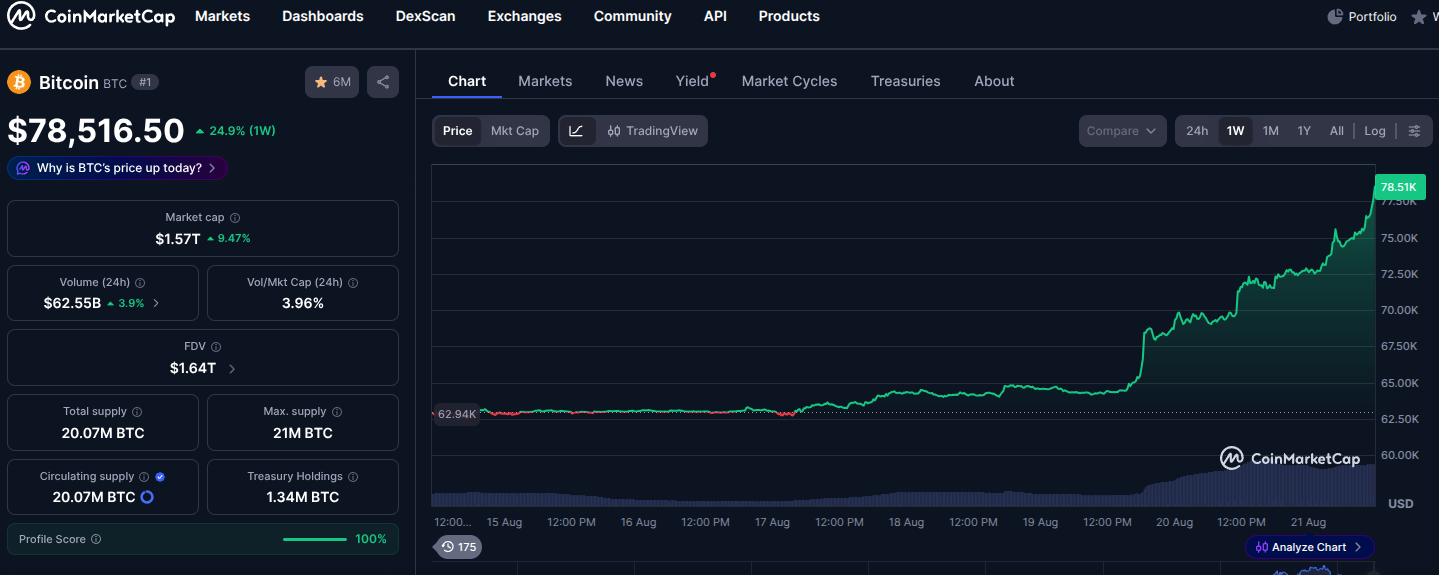
Bitcoin crossed $79,277.00 on August 21, 2026, completing a dramatic recovery from a 30-day low of $62,226.58. The move gave crypto investors a long-awaited positive signal after months of uncertain institutional flows and range-bound trading. Yet the most useful question is not whether the number feels bullish—it is whether the macro and spot-demand conditions can support the advance.
Market snapshot: August 21, 2026. Cryptocurrency prices change continuously. This educational article is not financial advice, and the cited level is not a prediction or guarantee.
What changed over the last month?
Bitcoin began the period with limited conviction. Price spent weeks near $62,000–$65,000 while investors weighed persistent inflation, the path of interest rates and mixed ETF demand. By August 21, the market had traveled from the supplied monthly low to above $79,000, an intraperiod rise of roughly 27.4%.
The final acceleration arrived quickly. That speed reflects a market where fresh demand met thin liquidity and heavy bearish positioning. A rally of this type can be both fundamentally supported and mechanically amplified.
ETF demand moved back into focus
U.S. spot Bitcoin ETFs produced stronger inflow sessions during August. Public reporting cited more than $500 million of net inflows in one session and approximately $1 billion over several consecutive days. These products provide regulated access for investors who may not want to manage wallets or exchange accounts directly.
ETF flows are not a guarantee of higher prices. They can reverse, and 2026 also contained meaningful outflow periods. However, renewed inflows during a breakout suggest that demand was not coming exclusively from offshore leverage.
Falling Treasury yields changed relative attractiveness
Long-duration U.S. yields declined as the Treasury expanded buybacks of older government bonds. Markets interpreted the move as supportive for liquidity. Lower yields reduce the relative appeal of holding risk-free debt and can encourage capital to move toward equities, commodities and cryptoassets.
Bitcoin is especially sensitive to liquidity expectations. It has a fixed issuance schedule, trades continuously and responds quickly when investors expect easier financial conditions or a weaker dollar. The relationship is not stable every day, but it was an important part of the August narrative.
Regulatory optimism reduced uncertainty
Constructive signals from Washington—including discussion of clearer crypto rules and meetings involving industry leaders—helped improve sentiment. A defined regulatory framework could support custody, trading and tokenization businesses, although proposals still need to become enforceable rules before investors can rely on them.
The short squeeze amplified everything
Large short liquidations forced bearish traders to buy Bitcoin back as price rose. Estimates reported for the broader crypto market reached billions of dollars. Forced buying explains why BTC moved through several price levels faster than ordinary spot demand alone might suggest.
This is also the central risk. Liquidation-driven momentum can weaken once vulnerable short positions are gone. Sustainable rallies typically need continued spot accumulation and healthy volume after the squeeze.
Reading the CoinMarketCap numbers
The provided 30-day panel listed a low of $62,226.58 and a high of $79,463.71, while the cited breakout level was $79,277.00. Rolling statistics and live quotes can refresh at different times, particularly during fast markets, so none of these figures should be treated as a permanent price.
What Kraken users should consider
Kraken users can follow BTC spot pricing, depth and order types, but they should decide their objective before placing an order. Dollar-cost averaging spreads timing risk; a limit order controls entry price; a market order may experience slippage during volatility.
Security remains essential during a rally. Use a unique password, strong MFA, withdrawal safeguards and verified bookmarks. An increase in price often brings an increase in phishing messages and fake support accounts.
Is this finally good news for investors?
Yes, in the limited sense that Bitcoin recovered important levels with more than one source of demand. ETF inflows and macro support give the move more substance than a random intraday spike. But “good news” should not become “guaranteed continuation.”
- Monitor whether ETF inflows persist.
- Watch long-term yields and dollar liquidity.
- Look for consolidation above former resistance.
- Avoid borrowing to chase a vertical candle.
- Keep custody and account security independent of market excitement.
Bitcoin’s move above $79,277 has restored optimism. Its durability will depend on real spot demand after the short squeeze fades and on whether the macro environment remains constructive.
Chart and price-range source: CoinMarketCap — Bitcoin. Snapshot captured August 21, 2026.